.svg)

.svg)


Your child avoids reading. Fidgets constantly. Struggles to stay focused during homework. It might look like they’re distracted, acting out, or just not trying.
But what if the real problem isn’t behaviour at all?
What if it’s their vision?
Many children with undiagnosed vision issues get mislabeled as having behavioural or learning problems. They don’t always say “I can’t see,” because they may not even know what clear vision feels like.
Let’s explore how to tell the difference, what signs to look for, and how to get your child the right support—before misdiagnosis leads to unnecessary stress for both of you.
When Vision Problems Look Like Behaviour Issues
Vision issues don’t always mean blurry eyesight. Sometimes, it’s about how the eyes focus, track, or work together. These subtle issues can impact a child’s ability to learn, read, or concentrate—without any obvious signs.
That’s where confusion starts.
Common Vision Conditions That Mimic Behavioural or Attention Problems:
- Hyperopia (Farsightedness): The eyes work harder to focus up close and far away, leading to eye fatigue, frustration, and fidgety behaviour—especially during reading or homework.
- Convergence Insufficiency: The eyes struggle to work together for close-up tasks. Kids may skip lines, lose their place, or avoid reading altogether.
- Amblyopia (Lazy Eye): One eye is weaker and may cause visual confusion or poor depth perception, making coordination or sustained attention difficult.
- Astigmatism: Blurred or distorted vision that can lead to headaches, squinting, or a general dislike of close work.
- Binocular Vision Disorders: Difficulty coordinating both eyes can cause double vision, fatigue, or avoidance of near tasks.
These conditions can all result in behaviours that look like inattention, resistance, or even defiance.
Behaviours That May Be Vision Red Flags
Here are some behaviours commonly mistaken as emotional or behavioural problems—but that may actually signal a vision issue:
- Avoiding books, puzzles, or fine motor tasks
- Trouble sitting still or paying attention during classwork
- Skipping lines while reading or using a finger to keep place
- Covering one eye, tilting the head, or squinting
- Complaints of headaches or tired eyes after school
- Frequent eye rubbing or blinking
- Difficulty copying from the board
- Poor coordination or clumsiness in sports
- Frustration or meltdowns during close-up tasks
These aren't signs of laziness or lack of motivation—they’re signs your child may be struggling to see clearly or comfortably.
Why It Matters
When vision problems go undiagnosed, children may be misdiagnosed with:
- ADHD
- Learning disabilities
- Behavioral disorders
- Processing delays
This can lead to unnecessary medication, incorrect academic placement, and reduced self-esteem. A child who is simply straining to focus may end up feeling like they’re “bad at school” or “just not smart enough.”
The result? A frustrated child, confused parents, and missed opportunities to truly help.
What to Do: Get a Comprehensive Eye Exam
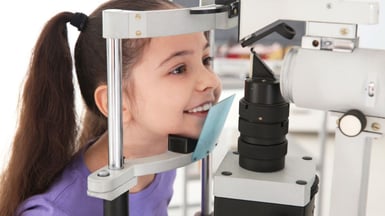
The most crucial step is to schedule a comprehensive eye exam with an optometrist—not just a quick screening at school.
These exams look beyond 20/20 vision and test how well the eyes:
- Focus
- Move
- Work together
- Handle near and distant tasks
- Process visual information
Even if your child hasn’t complained, and even if the school screening said they were fine, a full eye exam is the only way to rule out vision-related issues.
In Ontario, children's eye exams are covered by OHIP once every 12 months.
Treatment Options
If a vision issue is detected, the good news is that most are treatable—and often without medication or major interventions.
Common Treatments:
- Prescription Glasses: To correct refractive errors like hyperopia, myopia, or astigmatism
- Vision Therapy: Customized exercises that strengthen eye coordination, focus, and tracking
- Patching or Atropine Drops: Used to treat amblyopia and train the brain to use the weaker eye
- Prism or Specialty Lenses: For binocular vision problems or eye alignment issues
- Accommodations at School: Larger print, preferential seating, or scheduled visual breaks
The key is early detection. When vision issues are caught and treated, many children show dramatic improvement in attention, behaviour, and academic performance.
The Bottom Line
Before assuming it’s a behaviour issue, ask: could it be their eyes?
A child who’s acting out, distracted, or struggling in school may just be trying to see clearly or comfortably. And they may not have the words to tell you that.
The answer isn’t always in more structure or discipline—it might be in a pair of glasses, or vision therapy, or simply the right diagnosis.
Book that eye exam. It could change everything.