
.svg)

.svg)

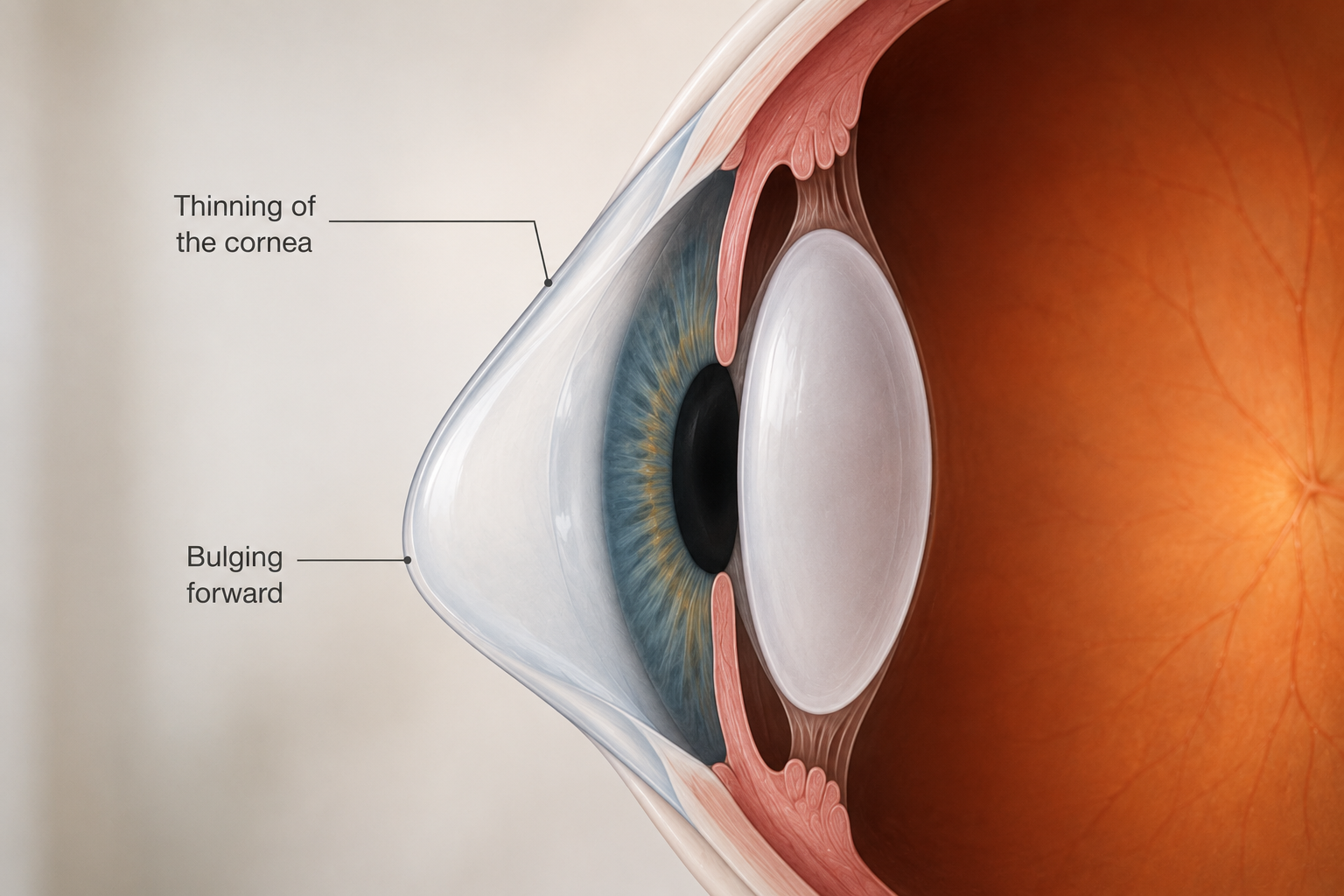
What It Is
Keratoconus is a progressive eye disease that affects the cornea, the clear front window of the eye.
The cornea becomes thinner and begins to bulge outward, creating an irregular shape that distorts vision.
This distortion makes it difficult to correct vision fully with glasses alone. The condition typically begins in the late teenage years or early adulthood and can progress over time.
Who It Affects / Risk Factors
- Usually develops between ages 15 and 30
- May be hereditary or occur spontaneously
- Linked to chronic eye rubbing
- More common in people with Down syndrome, chronic allergies, or connective tissue disorders
- Blurred or distorted vision 👁️
- Frequent changes in eyeglass prescriptions 🔁
- Sensitivity to light and glare 💡
- Difficulty seeing at night 🌙
- Eye irritation or strain 😣
- Corneal topography – creates a 3D map of the cornea’s shape
- Pachymetry – measures corneal thickness
- Slit-lamp examination – checks for visible thinning or scarring
- The outer corneal layer is removed under local anesthetic.
- The eye is soaked with riboflavin (vitamin B2) drops.
- A specialized UV light activates crosslinks that reinforce corneal structure.
Most patients notice improvement within 3–6 months, and only a small percentage need retreatment. - Rapid or frequent prescription changes
- Blurred or ghosted vision
- Increased light sensitivity
- Family history of keratoconus
Symptoms to Watch For
- Blurred or distorted vision 👁️
- Frequent changes in eyeglass prescriptions 🔁
- Sensitivity to light and glare 💡
- Difficulty seeing at night 🌙
- Eye irritation or strain 😣
How It’s Diagnosed
Your optometrist can detect keratoconus during a comprehensive eye exam using specialized imaging tests such as:
Early detection is key — optometrists often identify keratoconus before vision symptoms become severe.
Treatment & Management
The right treatment depends on the severity and progression of the disease. Optometrists may recommend:
👓 Eyeglasses or Soft Contact Lenses
For mild keratoconus, glasses or soft contact lenses can correct vision effectively.
🧿 Rigid Gas Permeable (RGP)/ Scleral Contact Lenses
For moderate cases, RGP lenses create a smooth tear layer over the irregular cornea, restoring clear vision. Scleral contact lenses are a larger diameter lens than RGP lenses. They are more suitable for moderate to severe cases of keratoconus.
🧬 Corneal Collagen Crosslinking (CXL)
A minimally invasive procedure that strengthens the cornea and slows or stops progression.
🔄 Corneal Transplant
For advanced cases with scarring or severe thinning, a corneal transplant replaces the damaged cornea with a clear donor cornea.
This procedure generally has a high success rate and can restore functional vision.
When to See Your Optometrist
Schedule an eye exam if you experience:
Early diagnosis enables timely intervention, helping prevent further vision loss and preserve sight.